
Why Granite Is the One Kitchen Countertop You Shouldn't Fit Yourself
Granite is the one countertop on the standard kitchen list where the gap between "confident DIYer" and "professional installer" is real, physical, and expensive to get wrong.
28/07/2026
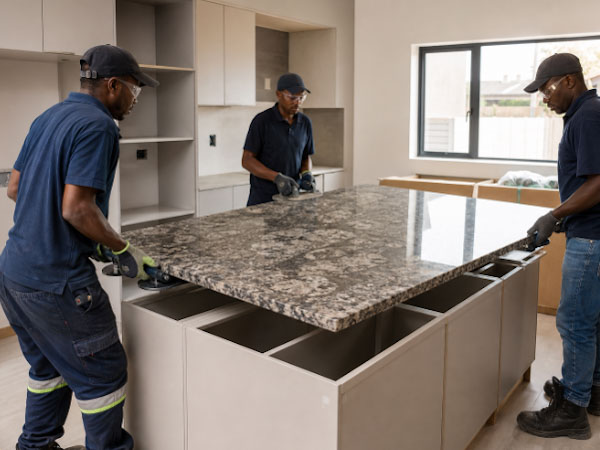
There's a short list of kitchen jobs I'll take on myself without a second thought, and a short list I hand straight to a crew. Formica sits in the first pile — a sharp knife, a straightedge and a steady afternoon gets it done. Timber I'll plane, seal and hang myself too. Granite sits in the second pile, every time, no exceptions.
That's not caution for caution's sake. It's the one countertop on the standard kitchen list where the gap between "confident DIYer" and "professional installer" is real, physical, and expensive to get wrong. Here's exactly why granite sits in its own category, and what to expect once you've decided to hire it out.
It's genuinely too heavy to handle safely
A full granite slab needs two people, often three, just to move it without flexing or dropping it. Laminate you carry under one arm and lay flat on a bench.
That weight is also why granite is bedded and adhered rather than simply set down. A slab that flexes even slightly during a lift can develop a hairline crack you won't see until months later, when it finally lets go along a stress line.
Templating is a precision job, not a tape-measure job
Every kitchen wall looks straight until you measure it properly. Real walls bow, cabinets sit a few millimetres out of true, and reveals under a window or splashback need to land exactly.
A professional templates the space — often digitally, sometimes with a physical pattern — to capture all of that before the slab is ever cut. That template also decides how the pattern in the stone runs across a seam: granite with strong veining needs the joins planned so the pattern lines up rather than jumping mid-slab, which is a decision made at the templating stage, not fixed afterwards.
Get the template wrong and you're not trimming an edge on site the way you would with laminate. You're looking at a slab that doesn't fit, can't be re-cut without losing the pattern match, and can't be returned.
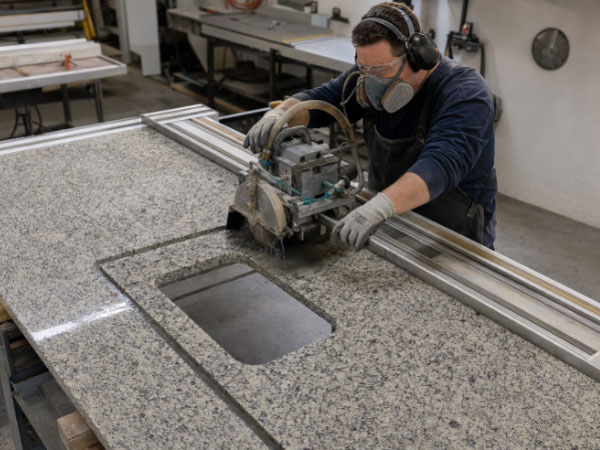
The cut-outs are where home jobs go wrong
Sink and hob cut-outs, and the mitred joints where two pieces meet, are where most DIY granite attempts fail. A domestic angle grinder run by an inexperienced hand tends to chip the edge or crack straight through the cut line.
Fabricators use rail saws, water-cooled blades and purpose-built jigs for exactly this reason. It's the single point in the job where the wrong tool does the most damage, fastest.
Specialist tools and polishing you won't own
Once a slab is cut, the exposed edge needs profiling and polishing to match the factory finish elsewhere on the top. That's specialist kit most homeowners will never own and would struggle to justify hiring for one job.
It's a small step on paper. Done badly, it's the difference between a countertop that looks finished and one that looks like it was cut in a garage.
Zero margin for error
Here's the honest reason the professionals exist. A ruined offcut of laminate costs you a sheet and an afternoon. A ruined slab of granite costs you the material budget for the whole job, with no cheap fix and often no way to source an identical replacement piece from the same block.
That's not a skills gap you close with a YouTube tutorial. It's a risk-to-reward calculation, and for most kitchens it doesn't favour doing it yourself.
Manufacturer guidance backs this up directly — Fabuwood's own installation notes treat granite fitting as a professional job from the outset, and MSI's own installation guidance makes the same point for anyone without hands-on fabrication experience.
What a proper granite quote should actually include
Once you've accepted this is a job to commission rather than one to tackle yourself, the next skill worth having is reading a quote properly. Not every quote covers the same ground, and the gaps are usually where the final bill grows.
A fair quote should spell out:
- Templating versus an estimate from a plan. A real site measure, done after your cabinets are installed, stops the number moving on installation day.
- Edge profiling, and which profile is priced in — a plain pencil edge and a bullnose are not the same line item.
- Sink and hob cut-outs, priced individually rather than buried in a vague "installation" total.
- Sealing, including the first seal after fitting.
- Delivery and access. Stairs, narrow passages or an upper-floor kitchen change the labour involved, and a quote that ignores access usually grows once the installer actually sees the site.
- Removal of the old countertop and offcut disposal, so you're not left arranging a skip yourself.
If you're at the stage of gathering a few quotes to compare against that list, a South African platform that matches homeowners with vetted granite installers is one way to line several up side by side rather than working through installers one at a time.
Some
kitchen jobs are genuinely worth doing yourself,
and Formica will always sit on my own-tools
list. Granite doesn't, and it never will.
Knowing exactly why, and knowing what a fair
quote looks like once you've hired it out, is
what protects your wallet either way.