
ThermoWood Decking and Choosing the Best Timber: What UK Homeowners Need to Know
ThermoWood delivers superior performance to larch on the durability scale, reduced moisture movement, and compatibility with hidden fixing systems that larch's dimensional variation makes harder to specify reliably.
04/08/2026
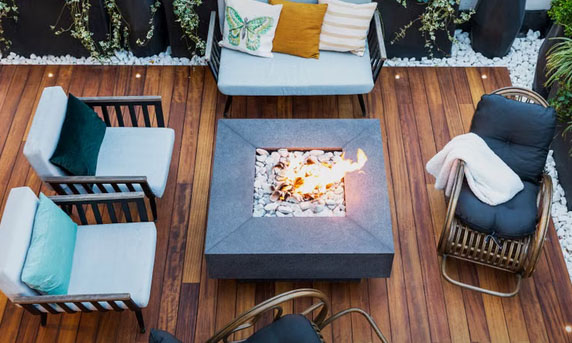
The choice of decking material is one of the most consequential decisions in any garden or outdoor living project. Get it right and the deck looks great, performs reliably, and requires minimal attention for decades. Get it wrong and you are facing annual maintenance cycles, premature board replacement, and a surface that looks worse every season rather than better.
In the UK market, the conversation about decking materials has shifted significantly over the past decade. Standard pressure-treated softwood — which dominated the market almost entirely a generation ago — has lost ground to premium natural species and thermally modified alternatives that offer genuinely superior performance without the chemical treatment concerns that increasingly conflict with sustainability-minded homeowners. Understanding what those alternatives are and how they compare is the starting point for any well-specified deck project.
Thermally Modified Timber Decking: The Science Behind the Performance
Thermally modified timber — sold under the ThermoWood brand — is produced through a process that is elegantly simple in principle: Nordic pine or spruce is heated to between 185 and 215 degrees Celsius inside a closed kiln, using steam as the processing medium, in the complete absence of oxygen. The process typically runs for 24 to 48 hours, after which the timber is gradually cooled and restabilised to a consistent moisture content.
The changes that occur during this process are permanent and structural. The hemicellulose in the timber's cell walls — the component most responsible for moisture absorption — is broken down and partially volatilised. The remaining material is a more stable matrix of cellulose and lignin with significantly reduced hygroscopic activity. In practical terms, this means ThermoWood absorbs up to 50 percent less moisture than untreated softwood, moves substantially less across seasonal cycles, and achieves Durability Class 2 without any chemical preservative — equivalent to oak, teak, and other naturally durable hardwoods.
For decking specifically, these properties address the two primary failure modes of standard softwood: the dimensional movement that causes boards to cup, split, and vary across seasons, and the biological decay that establishes itself wherever moisture, warmth, and accessible nutrition combine. ThermoWood reduces both. The result is a decking material that maintains its profile, its surface appearance, and its structural integrity for significantly longer than chemically treated alternatives — and does so without the handling restrictions, disposal concerns, or sustainability conflicts of preservative-treated wood.
The complete range of thermally modified timber decking boards UK is available from UK stock — covering smooth, grooved, brushed, and secret fix profiles in both standard and wide board dimensions. All profiles are pre-grooved for hidden fixing systems where specified, and full installation guidance is provided with every supply.
How to Choose the Best Wood for Decking in the UK
The UK's climate places specific demands on decking materials. Persistent rainfall across autumn and winter, combined with UV exposure through spring and summer and temperature swings across the seasonal cycle, creates a challenging environment for any timber product. The species that perform best in these conditions are those with inherent resistance to moisture ingress and biological decay — either through natural resin content, timber density, or modification processes like thermal treatment.
Siberian larch is the leading naturally durable species for UK decking — its high resin content and tight growth ring structure give it Durability Class 3 without treatment and a realistic service life of 25 to 30 years above ground. Its warm golden colour weathers to a distinctive silver-grey that suits the informality of UK garden environments particularly well. For homeowners who want natural timber character with minimal maintenance commitment, larch is the strongest choice at its price point.
ThermoWood delivers superior performance to larch on the durability scale — Durability Class 2, reduced moisture movement, and compatibility with hidden fixing systems that larch's dimensional variation makes harder to specify reliably. It is the right choice for projects where maximum longevity and minimum maintenance are the primary drivers, or where a secret fix installation is specified for aesthetic reasons.
Pressure-treated pine remains the budget entry point — acceptable performance at the lowest supply cost, but with a maintenance commitment and a service life trajectory that make it the least economical choice over a 20-year horizon when the full cost of annual treating and eventual replacement are factored in.
For a complete species comparison covering all the main UK decking timber options — with honest performance data, maintenance requirements, service life projections, and current supply costs — the what is the best wood for decking UK guide examines every option in detail to help homeowners make the right specification decision for their specific project, exposure, and budget.
Installation: The Decisions That Determine Outcome
The most durable timber species underperforms in a poorly detailed installation. The critical installation decisions for any deck are the subframe specification, fixing system, drainage fall, and ground clearance. Joists should be of adequate depth for the design span, specified in a naturally durable or treated timber, and positioned to provide adequate support at board ends and joints. Ground clearance of at least 150mm beneath the lowest board ensures airflow and prevents moisture accumulation.
Fixing choice — face-fixed screws or concealed clip systems — affects both appearance and longevity. Concealed clips eliminate surface penetrations that become moisture entry points over time. For ThermoWood specifically, the reduced seasonal movement means hidden fixing systems maintain their specified gaps consistently, producing a cleaner result than the same system would on standard softwood. Stainless steel fixings are mandatory throughout — galvanised fixings corrode in contact with the natural resin of premium timber species and produce staining that cannot be removed without sanding.