
Hiring a Thatcher: What I Wish I'd Checked Before the Work Started
Thatch done properly, by someone who actually knows the craft, is one of those things that quietly makes a house feel like a home — and it's worth every bit of the checking to get there with the right person on your roof.
30/07/2026
The first quote I got looked great, and that was exactly the problem. Lowest number by a good margin, a friendly guy on the phone, and he could start Monday. I nearly said yes on the spot.
Looking back, every warning sign was already there. He couldn't give me an address of a past job I could go and look at — "clients don't like that," he said. Insurance was "sorted, don't worry about it." The whole quote was one line: "thatch roof, R18000, deposit 50%." No scope, no material, no timeline.
I didn't take that job in the end, mostly on gut feel rather than anything I could point to. But it rattled me enough that by the time I actually hired someone, I'd built a proper list of what to check first. Here's that list — the short version of what I wish someone had handed me before I said yes to anyone.
Start with the one mistake that costs the most
Hiring on price alone is the expensive mistake, because you only find out how expensive once the roof leaks the second summer. Thatch isn't a commodity like a bag of cement where one supplier's product is the same as the next. It's a craft. Two thatchers can quote for "the same roof" and produce completely different results, because so much of the quality lives in the person doing the work — how tightly they pack the reed, how they finish the ridge, whether they understand your roof's pitch and exposure.
So before you look at a single rand figure, shift the question from "what's it going to cost me" to "who's actually going to do this." Everything else on this list flows from that.
Ask for references you can actually go and see
This is the single most useful check, and the one people skip because it feels awkward. Don't settle for a name and a thumbs-up over the phone. Ask for an address of a completed job — one you can drive past — or a phone number of a homeowner willing to talk to you.
A thatcher who's proud of their work will hand this over without hesitating. Someone who gets vague, or suddenly remembers that "clients prefer privacy," is telling you something.
When you do get hold of a past client, keep it simple:
- Did it leak? Even in a proper Highveld thunderstorm.
- Did they finish when they said they would? Weather delays happen, but chronic no-shows are a pattern, not bad luck.
- Would you use them again? The most honest question you can ask, and people usually answer it straight.
Get insurance and a workmanship guarantee — in writing
These are two separate things, and both need to exist on paper, not just as reassurance over the phone.
First, the thatcher's own insurance — so if someone falls off your roof or damages something on site, it isn't suddenly your problem to sort out. Ask to see proof, not just hear about it.
Second, a workmanship guarantee that spells out what's covered and for how long. "I stand by my work" is a nice sentence. It isn't a guarantee until it's written down.
If checking all of this yourself feels like a lot — because it is, especially if thatch isn't something you deal with every day — this is the exact gap a Gauteng service that matches homeowners with vetted independent thatchers exists to close. It checks a thatcher's experience and references, their insurance, and whether they offer a workmanship guarantee, before it ever puts a name in front of you — so you're not doing all this verifying entirely alone, and you still deal directly with whoever ends up doing the work.
One thing this list can't help with: your own home insurance. Thatch roofs often come with specific requirements from insurers around fire and compliance measures, and those requirements vary by policy. This is information, not advice — confirm what your insurer or broker actually needs directly with them, before you assume anything is automatically covered.
Pin down scope and materials so nobody "assumes"
Remember that one-line quote I mentioned? That's exactly where disputes get born — not from bad faith, usually, but from two people assuming different things and never saying so out loud.
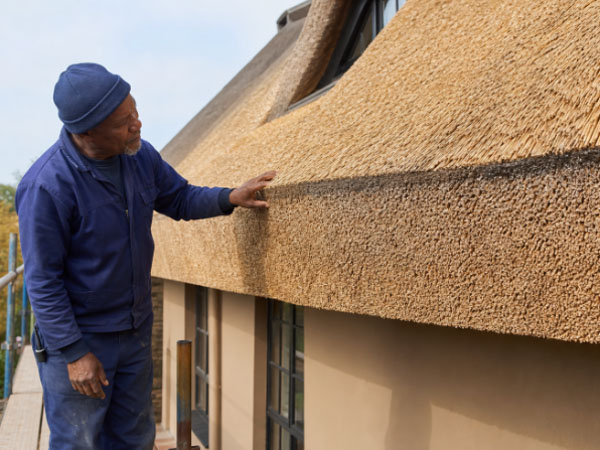
Get the scope written out properly: is this a full new roof, a re-thatch of an existing structure, or a repair — and just as importantly, what's excluded. "Thatching the roof" can quietly not include the ridge capping, or the gutters, or clearing the old material away.
Get the material named too. Cape reed and thatching grass aren't interchangeable, and the grade and thickness used changes both the look and the price. "A thatch roof" can describe very different jobs at very different price points, and the only way to know which one you're buying is to see it named on paper.
None of this is about pinning someone to an exact final price before they've even seen your roof properly — that's not realistic. It's about making sure the words on the quote mean the same thing to both of you.
Compare a few quotes — not for the cheapest, for the clearest
Once you've got two or three quotes in hand, resist the urge to just scan for the lowest number. Read them side by side instead, and look at how each one handles scope, materials, timeline and payment stages.
The quote that spells all of that out clearly is usually the one from someone who does this properly and has nothing to hide. The quote that's vague on all of it — even if it's cheaper — is telling you something about how the job itself might go.
A good spread of quotes also teaches you what "normal" looks like for a roof like yours, which makes the outlier — too cheap, too vague, too rushed — much easier to spot.
The red flags I'd walk away from now
A few things that, on reflection, should have sent me running the first time round:
- Pressure for a big cash deposit upfront, especially if it's framed as urgent or time-limited.
- "Insurance is sorted, don't worry about it" with nothing offered in writing.
- No past job you're allowed to see or a client you're allowed to speak to.
- A quote that fits on one line, with no scope, material or timeline detail.
- Anyone who calls thatch "fireproof." It isn't, and it can't be. Treatment can make it catch less easily and slow a fire down once it starts, but the risk is dialled down, never switched off — which is exactly why bodies like the Thatchers Association of South Africa publish standards for this kind of work, and a thatcher who waves away fire safety altogether either doesn't know their trade or isn't being straight with you.
- No mention of lightning protection, particularly if you're anywhere on the Highveld — this part of the country sees serious lightning activity most summers, and a thatch roof without protection is a real risk, not a theoretical one.
Any one of these on its own might have an innocent explanation. Two or three together, and it's time to keep looking.
Worth every bit of the checking
I didn't have this list when I needed it, and I got lucky rather than clever the first time round. You don't have to. Thatch done properly, by someone who actually knows the craft, is one of those things that quietly makes a house feel like a home — and it's worth every bit of the checking to get there with the right person on your roof.