
How to Choose Wallpaper You Won't Regret: A Practical Checklist for South African Homes
Choosing wallpaper no longer has to be a leap of faith if you follow this checklist and you'll know — not hope — that your choice works before you spend a cent.
06/07/2026
Wallpaper is having a moment in South
African homes — feature walls in lounges, murals
in nurseries, textured panels behind headboards.
But it's also one of the more nerve-wracking
décor decisions you can make. A pattern that
looks striking as a thumbnail on your phone can
feel overwhelming stretched across a three-metre
wall, or a colour that looks like it should work
with your furniture actually clashes.
The good news: choosing wallpaper no longer has to be a leap of faith. Follow this checklist and you'll know — not hope — that your choice works before you spend a cent.
How do I know if a wallpaper will suit my room?
The short answer: don't imagine it — preview it. The single most useful step you can take before buying wallpaper is to see the actual design on your actual wall, in your own light, with your own furniture in frame.
Until recently that meant ordering physical samples and waiting days for delivery, or taping a printout to the wall and squinting. Today you can do it in seconds with a room visualiser: you photograph your wall on your phone, and the tool renders your chosen design onto it in a before-and-after view.
Room visualisers are well established overseas but still rare among South African wallpaper retailers. One of the first local options is the free Room Visualiser from Wallpaper Online, the Johannesburg-based wallpaper manufacturer — it runs in any browser, needs no app or account, and works straight from the product page: find a design, tap the visualise button, and snap or upload a photo of your room. You can test as many designs as you like at no cost. Try it at wallpaperonline.co.za/wallpaper-room-visualiser-south-africa.
Why bother? Because seeing a design in context changes decisions. According to visualisation technology provider Roomvo, shoppers who preview products in their own space are roughly five times more likely to buy, and returns drop by about a third — because people know exactly what they're getting. Even a quick phone snap of your wall will tell you immediately whether that bold botanical is a dream or a mistake.
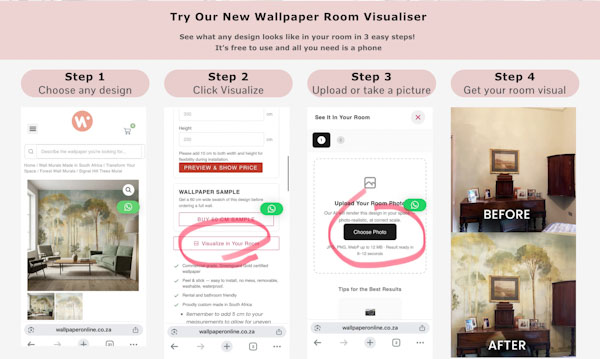
Checklist step 1: photograph your wall and preview your shortlist in a visualiser before ordering anything.
What should I look at when previewing a design?
When you have the design on your wall (virtually), judge it against four things:
- Scale. Large-scale patterns and murals need room to breathe — they suit feature walls and open spaces. Small repeating patterns can handle busier rooms but may read as noise from a distance. The preview makes scale problems obvious in a way a swatch never will.
- Light. South African light is strong and directional. A north-facing room in Johannesburg gets warm sun most of the day; a south-facing coastal room can be cool and grey. Preview your wallpaper using a photo taken at the time of day you actually use the room.
- Existing furniture and floors. You're not decorating an empty white box. The visualiser shows the design against your couch, your curtains, your floor tone — which is where most "it looked different online" regrets come from.
- Mood versus commitment. If you love a bold design but hesitate, preview it on the smallest wall in the room rather than the largest. A statement wall you adore beats a whole room you tolerate.
Which wallpaper type is right for my wall — peel and stick, traditional, or fabric?
Once the design is settled, the material decision is mostly about your walls and your living situation.
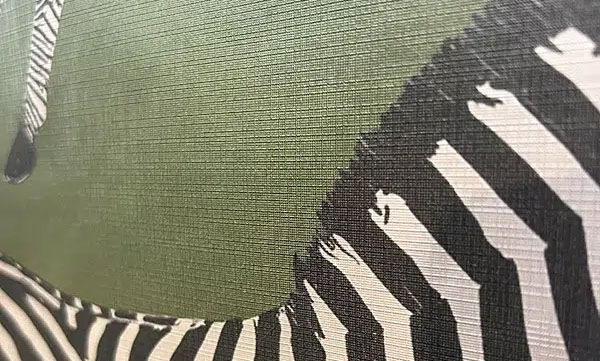
Peel and stick is the renter's and DIYer's answer: it goes up without paste, comes off cleanly without damaging (good quality) paint, and a feature wall is a realistic weekend job. It suits smooth, painted walls best. It's also no longer limited to flat, glossy finishes — textured peel-and-stick ranges have recently arrived in South Africa (Wallpaper Online released a textured peel-and-stick series this winter), giving you the tactile depth of linen- and weave-look finishes with the same removable convenience.
Traditional paper wallpaper is the classic paste-up option — economical for larger installations and the familiar choice if a professional installer is doing the hanging.
Fabric-based wallpaper (such as DuraMatte-type finishes) is the answer to a very South African problem: textured plaster walls. Where thin peel and stick or paper will show every bump, a heavier fabric wallpaper sits flatter and more forgiving on indentations or lightly textured plaster, and holds up well in high-traffic areas.
If you're unsure which applies to you, the honest test is to run your hand across the wall. Smooth and painted? Peel and stick is the easy win. Lightly textured plaster or old walls with history? Look at fabric. If your wall is heavily textured then it’s best to run a skim coat over it before applying any wallpaper.

Do I still need a physical sample?
Sometimes, yes. A visualiser answers the big questions — colour, scale, overall effect — which is where most expensive mistakes happen. A physical sample answers the small ones: exact texture underhand, sheen in your light, print quality, exact flat colour (remember your phones screen will affect the colour you see).
If you're papering a whole room or your wall has an unusual finish, do both: shortlist with the visualiser (it's free and instant), then order a sample of your final one or two candidates. You'll make one confident purchase instead of two hopeful ones.
What's the biggest wallpaper mistake to avoid?
Buying from imagination. Nearly every wallpaper regret — too dark, too busy, clashes with the floor, wrong undertone — is a preview failure, not a product failure. The design was always going to look that way in that room; the buyer just couldn't see it in advance. Now that previewing takes less than a minute and costs nothing, there's no reason to gamble.
The complete checklist, in order:
- Photograph your wall and preview shortlisted designs in a free room visualiser.
- Judge the preview on scale, light, furniture, and commitment level.
- Match the material to your wall: peel and stick for smooth walls and renters (including the new textured peel-and-stick options), traditional for classic installs, fabric for textured plaster.
- Order a physical sample of your final candidate if texture or sheen matters.
- Measure twice, order once — and enjoy a wall you chose with certainty.
Wallpaper should be the fun part of decorating. Take the guesswork out first, and it will be.