
Should I leave my shelves open?
Open shelves are so very cool, but what to put on them? A designer offers two solutions...
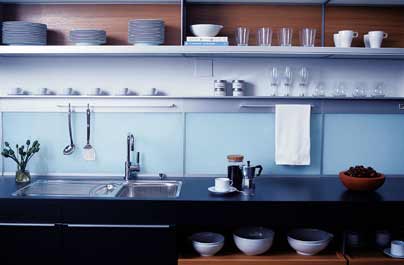
Interior designer Arden Nelson says that when clients request open shelving in their new kitchens, she first focuses on function. "Do they entertain a lot? Cook mostly for themselves? Is this a family with small children? Is wine important? Do they drink coffee twice a day?" she asks. "Every situation is unique."
Once she has established a sense of the clients’ needs, she helps them decide what can be displayed on the shelves and what might be better stored in drawers, cabinets, and pantries. While an open-shelving project sometimes involves a few new acquisitions - the perfect glass canister for coffee beans, say, or a set of shiny new white cups - mostly it’s an editing job. You need to pare down, assess, rearrange, then pare down some more. "Much of the time, open shelving becomes a messy area, to tell you the truth," says Pari Darvish, a designer at Poggenpohl, who believes the trend is not for everyone. "You have to be disciplined."
We asked Nelson to show us how she’d arrange kitchenware and food items in a sleek Poggenpohl kitchen with two long aluminum and glass shelves along the sink wall and slide-out open shelves below the laminate countertop.
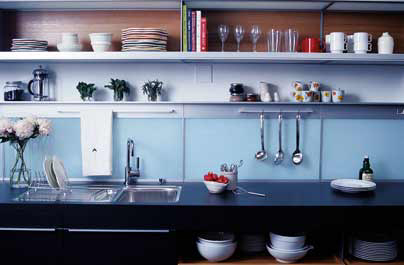
The surface below your shelves is an important part of the view. Stash small appliances in cabinets, potholders in drawers. And learn to see what you’re not seeing - that dish soap looks so at home next to the sink, it’s practically invisible. Except it’s not. Hide it down below.
DESIGN RULES
- Be choosy about cookbooks. Keep a special few close at hand and shelve the rest somewhere else. Book jackets? Get rid of them for a cleaner look.
- Too many colours in a small space can get visually chaotic.
- Vary heights gradually. A motley mix of tall and short items can look busy.
- Think neat, but casual. Pieces don’t have to be positioned with military precision. Letting the stacked flowered mugs go slightly askew (and asymmetrical) keeps the look informal.
- Vary shapes and materials
- Look at your silhouettes. If they’re all different, the look can seem jumbled. Too similar, and it’s static. Mix hard and soft: bouquets of fresh herbs make a pleasing contrast with harder-edged items.
- No matter how much coffee you drink, bags of beans don’t need to be in view. Transfer bulk food items, including spices that you use frequently, to attractive jars. Boxes of cereal and bags of chips? Straight to the pantry.
- Clear glass, white china, and metallic touches make a cool background for a few pops of colour. Chic restaurants tend toward this quiet palette for their tabletops
- it makes food look luscious.
- Simply stacked plates and elegantly spaced cups and glasses have their own minimalist beauty. Symmetry can be soothing.