
How green is your roof?
Green Roof Shelter’s green roofed containers provide a selection of simple, robust, small buildings, each planted with species for nectar loving bees, butterflies and insects, and providing habitat and nesting opportunities for birds, bats, and a large variety of invertebrates.
Green Roof Shelters' Container Home Office has a native wildflower growing roof, providing nectar and habitat for bees, butterflies and other invertebrates. Nesting boxes for birds are incorporated into the roof overhangs. Other nesting opportunities provided are bat slots for pipistrelle bats to inhabit enclosed roof spaces, and open-fronted nesting for birds such as robins. Wood piles on the roof also provide wildlife habitat and shelter.
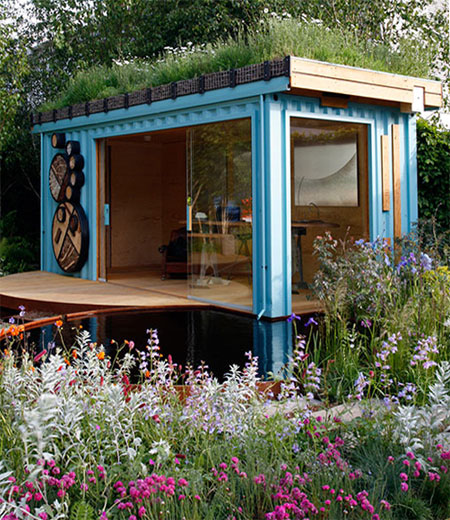
A sophisticated conversion of a recycled shipping container. Fair-faced spruce plywood lines the walls and ceiling - a warm inviting cabin feel that is practical and stylish. It can easily be painted if desired, and is a strong material to fix shelves, picture frames, or lighting to. Power sockets, telephone and data cabling is already installed for easy telephone/ broadband connection. Simple fully glazed sliding doors barely interrupt the transition between the garden and the home office.
Much of the materials in a Green Roof Shelter Home Office are reclaimed, re-used, or recycled. From the re-used container itself, timber used as cladding and fascia's, reclaimed aggregates and substrates for planting, recycled plastic 'lumber' for rot proof retaining plates. Habitat panels combine a mix of found materials for invertebrate nesting and overwintering. Nesting boxes for birds are incorporated into the roof overhangs. Other nesting opportunities provided are bat slots for pipistrelle bats to inhabit enclosed roof spaces, and open-fronted nesting for birds such as robins.
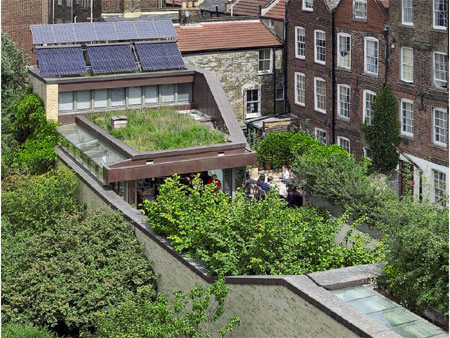
Started in 2002, when this self-build house is completed it will be one of the most ‘rounded’ ecological buildings in the UK. The Bere family home was started as a self build project in 2002, a few years before Justin discovered the German Passivhaus approach and technical methods that had been developed some years earlier by the German physicist Wolfgang Feist and colleagues from Sweden and USA.
bere.co.uk
In 2002, five years before the UK's first building was certified by the Passivhaus Institute, and before he discovered German passivhaus developments in Germany, Justin started on site with a building that almost exactly complies with the requirements of passivhaus certification (correct wall and roof u-values, design against thermal bridging, triple glazed windows throughout, attempt at air tight construction and the installation of a heat recovery ventilation unit).
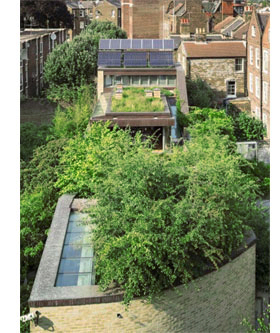
The house is also one of the early examples in the UK of a house covered in green roofs with varying soil depths for native ecological habitats.
Located immediately behind a terrace of four Grade 1 Listed heritage houses, the roofs contain a garden oasis for residents in the neighbouring taller buildings to look down upon.
A primary objective of this project is to redefine the language of architecture by the development of forms that are directly generated by the acceptance of the ecological imperatives of the 21st century.
Reduced energy costs, improved sound insulation, reduced heat island effect in urban developments, and the greening factor as just some of the benefits of a green roof.
Green roof design is available here in South Africa: