
Urban landscaping
How do you create a garden with in a small space that's packed with interest? Planting obviously helps, but it can take up lots of room, so ideally should be kept to a minimum - and those plants you choose should be architectural showpieces. Ideally, then, your hard landscaping has to do the talking.
Define your spaces
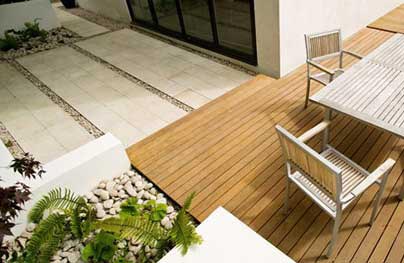
Changes of level or material underfoot are a good design trick. Above, a length of deck sits between two areas of paving. Just as it would indoors, this change of flooring defines the dining space within the garden, soften the effect of the paving and adds visual interest.
Create a quiet space
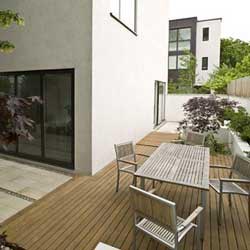
The far end of the this garden has been set aside for a small seating area. This garden is very sheltered on every side, but the principle remains solid - if you can find a space within your garden that's hidden from view, protected from the wind and is quite separate from the rest of your garden, you've got the ideal chill out spot. In a small or awkwardly shaped garden, like this one, this has been achieved with the addition of a half-wall that hugs the bench.
Think about detail
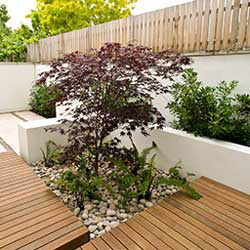
In an urban or contemporary garden, your design is likely to be very simple to make the most of the space. This is where attention to detail really pays off - here in the form not only of juxtaposed materials, but in the play of angles - the decking runs in one direction, while the lines within the paved area of the garden run in another. This not only looks more interesting, it plays a visual trick, too, since the eye is drawn along the lines, creating the impression that the garden is longer in every direction than it really is.
Consider your planting
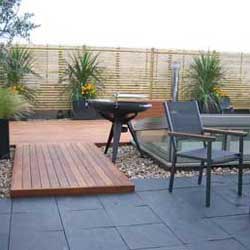
In a small urban garden, your view is going to be more important than that of a country garden that's surrounded by trees and an abundance of plants all year round. So, it's important to make your planting count right from the word go - and this means picking plants that are in leaf - or at least interesting to look at - in every season.
Use colour to exaggerate your design
A paint colour or stain - whether on a wall or fence - can make a huge impact on a garden. Apply the same rules as you would inside the house: use bright white to make a small, dark space seem bigger and lighter; use exuberant colour to show off your furniture and plants and to create an exotic looking garden; choose somber greys and blacks to contrast with your planting and create a very modern look.
Break up the landscaping
At design stage, remember to leave areas within your hard landscaping - assuming you're decking or paving most of your garden - free for planting. A specimen tree set into a large expanse of deck, a colourful flowering shrub sat in a corner or a row of blooms will soften the harder features of an urban garden, add colour and scent and attract wildlife.