Working with a Router and Router Bits
The most common use for a router is to add shapes and profiles to the edge of a project. Before the router was invented, early woodworkers had to use special planes fitted with custom blades to create these patterns.
With a router and a pilot bit, you can create the same shapes in a matter of minutes. Few tools are as accurate as a router; many woodworkers use a router to straighten and smooth joints that must be cut to the highest tolerances.
Using Router Bits
The bit is arguably the most important element in ensuring a quality finish and a good clean cut. There are a wide variety of router bits available today.
Carbide vs. HSS bits
The vast majority of bits on the market today are carbide tipped. Carbide is an extremely hard material. Its density actually rivals that of a diamond. Carbide has a number of advantages; it s very resistant to heat, and it keeps an edge (stays sharp) longer than steel. It does have a number of drawbacks; it s very brittle, prone to chipping, and it s very expensive. This is why most bits are carbide tipped and not made from solid carbide.
HSS bits (High Speed Steel) were the only type available for a number of years. They are still available from a number of hardware stores. HSS bits are best suited for occasional work as these bits are considerably less expensive than a comparable carbide bit. HSS bits tend to dull relatively quickly and need to be re-sharpened to keep from burning the wood surface. A carbide bit can last up to 20 times longer that a HSS bit - making it far cheaper in the long run.
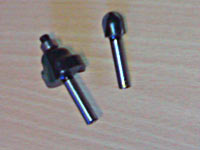
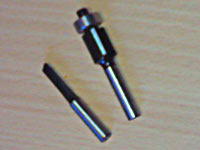
There are two different types of bits; Pilot and Non-Pilot. Pilot bits are fitted with a ball bearing that keeps them a fixed cutting distance from the edge of the wood. They are used most commonly to rout a profile on the edge of a workpiece or as a flush trim bit. Non-pilot bits do not have a bearing and are used in conjunction with a fence or jig of some sort to control their cutting paths.
Using a pilot bit
If you are using a pilot bit make sure the bearing rotates freely. A frozen bearing can burn the edge of your workpiece. There are two things to remember when using a pilot bit. First, don t push too hard or you risk denting softwoods with the bearing. Second, be sure to apply enough pressure to keep the bearing pressed against the wood. If it is allowed to spin on its own, it may burn the wood.
Pitch and tar
When working with some woods, pine in particular, it is inevitable that pitch and tar will build up on your bit. This pitch can force the bit and router to work harder. This generates excessive heat, which reduces bit life. Pitch and tar can also collect on the surface of the bearing. This can force the bit to roll unevenly and "bounce" on the surface, leaving a rough finish. Pitch and tar can often be scraped off with a scrap of wood or removed with a commercial bit cleaner.
Bit and collet condition
The condition of your bit and collet are important to the quality of your work and your personal safety. Inspect your collet regularly for signs of wear; replace immediately if you suspect any damage. Rust and corrosion on either the bit or the collet reduce the collet s holding power. Keep the collet and bit free of lubricants that might loosen this bond. Always insert your bit all of the way into the collet and then back it out a little (2mm). This will help insure it is properly seated. Make sure the collet is free from sawdust, shavings, or any other foreign bodies. As a safety precaution, you can mark a vertical line on your bit shank and a matching line on your collet. Line the two lines up. After you finish using your router check the lines. If they are not lined up any more, your bit is slipping in your collet. This is a sign that it might be time to replace the collet.
- Solid Bit A router bit machined from a solid piece of steel. In some cases a screw is mounted on the top for the bearing.
- Pilot Bit A router bit fitted with a bearing or less commonly, a steel pin coming from the top. The bearing rubs the edge of the workpiece and limits the cut of the bit. The bearing spins at the rate the router is moved while the bit spins at the speed of the router. Different size bearings can be used to achieve different depth of cuts.
- Arbor The arbor is the shaft of a router bit that typically fits into the collet.
- Collet - In a router, the collet is the sleeve that grips the shank on a router bit.
- Shank - The part of the router bit that is inserted into the collet.