
Energise your home
Inject personality, colour and style into your home with the wide range of textiles, wall coverings and decorating options available to South African homeowners.


When decorating your home - either for the first time, or simply to refresh your existing decor - it is important to choose the right fabric for soft furnishings. We asked interior design guru, Marcia Margolius, to share some of her tips with us. Marcia Margolius is the author of several home decor books, and force behind the best selling, annual publication, SA Decor and Design. The 12th edition of SA Decor and Design is now available.
Visit: www.sadecor.co.za for more information.
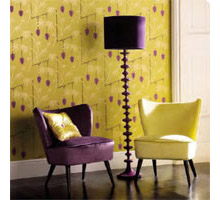
1. Bear in mind when ordering fabric quantities in excess of a ‘piece’ (approx 50 metres) that there could be colour variance from roll to roll. Fabrics are printed or dyed in batches, and each batch is likely to be slightly different.
2. ‘Railroaded’ patterns are specially designed for upholstery, and cannot normally be used for curtaining. The pattern repeats along the length of the roll where the design stands vertically between the selvedge. If one tries to join widths in the normal way, the design direction will become horizontal (i.e. the pattern will seem to be lying on its side).
3. Prints can also change from one batch to another, but the more colours are used in the design, the less noticeable the differences will be. If the cotton look and character is what you’re after, there is no substitute for it; just remember that plain dyed cottons will fade more readily than polyesters, acrylics and viscose.
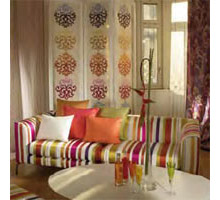
4. Pattern matching of vertical stripes and fabrics with a random all-over pattern is relatively simple, and is more suited to multiple drops and larger surfaces. Always check your fabrics for flaws before cutting. While most fabric distributors will normally allow a full credit if fabrics are returned, once material has been made up, it is rendered worthless and you cannot be refunded.
5. Be extremely careful when making up materials with a horizontal pattern. Almost all fabrics are skew due to the weaving and finishing processes, and whenever a line is visually ‘picked up’ across the width, the problem of matching arises. Skilled curtain makers often straighten material on the table before sewing, merely ‘easing’ it into shape by pulling it gently.
6. Certain fabrics tend to be less stable than others, resulting in shrinkage or ‘dropping’. Sometimes materials ‘pucker’, especially fine yarns such as silk. It helps to hang the curtains in situ before hemming to allow the fabric to stabilise. Only then should hems be hand sewn in.