
Get in focus with the times
Technology has come a long way, but if your TV set is still atop a turn-of-the-century chest of drawers, you need to get with the program and rethink your media room needs.
Keep in on the level
Always check the screen sizes that the wall-mount bracket says it can hold, and stay within the appropriate range. You should also check the maximum weight a bracket can hold and make sure that it can support your TV. And think about where you’ll really be when you’re watching television to make sure you place the wall mount appropriately. The last thing you want to do is spend all afternoon installing a system on your bedroom wall and then crawl into bed, turn on the TV and discover that your toes block out half the screen!
Don't get square eyes
Experts say that you should sit at a distance 3 to 6 times the diagonal width of the screen. For high-definition, wide-screen TVs, sit at a distance 1.5 to 3 times the diagonal width of the screen. If you sit too close to the TV, you give up sharp picture detail. If you sit too far, you may 'see' more detail than the eyes can perceive. Generally, 2 metres is considered the optimal distance when flat panels have 1080i/p resolution. A good ratio to keep in mind is to sit at a distance of about twice the diagonal of the screen, so the room needs to be able to accommodate that. But it also depends what you’re using the television for.
In view or out of sight
Sure, you may plan to spend a lot of time staring at the screen and channel-surfing, but since an entertainment centre can take up a lot of space, plan for how you want it to fit in with your décor. Think about how you want your components to look after they’re installed. Do you want to show off the equipment as a design statement or do you want to make it go away when you’re not using it? You need to decide if you want it to be visible or blend in. Seeing row upon row of CDs isn’t everybody’s idea of decoration, but whether or not you do that depends on how you want to organize the room.
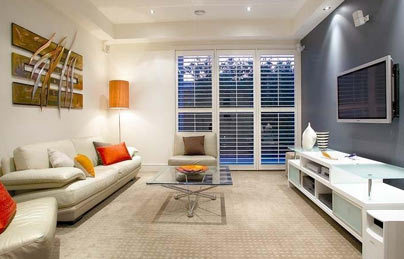
In fact, you can make your TV part of the décor rather than just hide it or show it off. With all the different styles of flat screens, you have a lot more flexibility with where you place them. You no longer buy a TV and automatically stick it in a cabinet. A lot of people mount TVs on a feature wall as if it were a painting, and program the screen to show a shifting display of art when they’re not watching it.
Sensible positioning
Having a window back-light the set is an invitation for eyestrain and headaches. Ditto on letting sunshine hit the screen and create glare. Experts say you need to face the TV away from any windows and use window treatments to prevent picture washout. To further reduce eyestrain and glare, place a light with a 10- or 15-watt incandescent bulb behind the TV. Choose a white light rather than pink to enhance the accuracy of onscreen colours.
Consider power sources
When buying the components of your home entertainment system, take note of which pieces need to be plugged in to make sure you’ll have enough power sockets. Depending on the type of sound system you choose, it may need its own dedicated plugs. You can get a big TV with a surround-sound system and some of those have a sub-woofer that needs to be plugged into power.
If you have home entertainment equipment, computer equipment and an appliance or two plugged into the same power socket, you could be setting yourself up for power failure, not to mention equipment failure. If you live in old house, it wasn’t built to accommodate all the electronics you use today. While a lot of today’s electronics don’t always pull a lot of power, it’s likely that the power socket isn’t going to a circuit dedicated just for that room. The circuit is probably shared with other areas of your home. To tell how much power can go to each circuit, hire an electrician to test them for you.
Keep it cool
There needs to be room around your equipment for air to circulate. If you’re converting a vintage piece of furniture into a TV cabinet, remove the back. If you take off the back, that can give you airflow, and you’ll still be able to close the doors over it in the front. You need to be concerned about heat because, over time, it can damage or destroy the components.