
Water... use it twice!
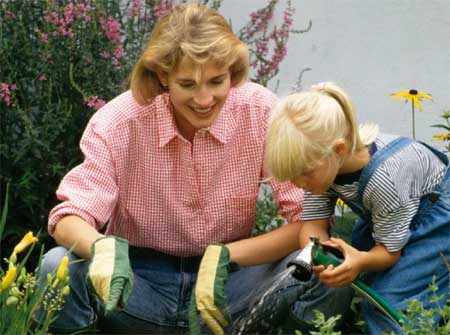
Harvesting grey water in your home is a good way to save this natural resource. Instead of letting bath and shower water pour down the drain, re-use it to water your garden.
The average suburban family of four will use much more than 200 litres of water each day for washing. You pay for water every time you turn on the tap, you pay to have it heated in your geyser and you pay to have it removed from your property through the sewerage system.
Grey water systems give homeowners the chance to collect grey water and use it a second time for garden irrigation - saving between 30 and 50 percent on water costs.
Collecting grey water and using it for irrigation can be a big part of your water-saving programme at home, but it must be approached correctly to avoid endangering the health of your family and pets and damaging plants in your garden.
What is grey water?
Grey water is the name given to waste water coming from different sources in the home. It isn't fresh water as it contains soaps and other residues like toothpaste and beauty products, but it isn't black, sewerage water, which contains toxins and harmful pathogens.
You can safely harvest grey water from your bathroom and use it on your garden. Water from your kitchen sink or dishwasher should not be re0used at it may be contaminated with harmful chemicals, plant and animal fats and bacteria.
How to store grey water
Firstly, it is important to note that grey water should not be stored for longer than 24 hours, as it becomes anerobic and full of pathogens, which are harmful to your health. Only when a purification system is installed can you safely store grey water for use over a period of time.
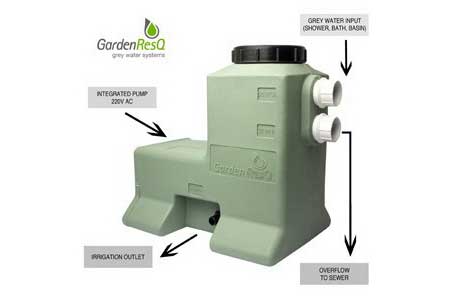
Garden ResQ is a compact water-saving system designed and manufactured in South Africa. It is a DIY-friendly product that will take only a few hours to install. Using an integral pump to divert water from your bathroom to the unit, a dual filter then removes any foreign matter. The advantage of this system is that it features a 'return to sewer' facility where water can be diverted into the sewerage system if you cannot use it.
Are you serious about saving water?
Since 2001 Pontos GmbH - an independent subsidiary and brand of Hansgrohe - has the high aspiration to meet ecological demands in accordance with nature.
The AquaCycle of Pontos recycles shower and bathwater in a patented biological-mechanical process without chemical additives. It guarantees constantly high water quality that conforms with the European Directive 76/160/EWG for Recreational Water.
The process: Safe for the environment - safe in use
First, the grey water from showers and bathtubs enters a filter which retains coarser particles such as textile fluff, hairs, etc. The filter is cleaned automatically and the residues are fed into the waste water drain.
Pre-filtration
First, the grey water from showers and bathtubs enters a filter which retains coarser particles such as textile fluff, hairs, etc. The filter is cleaned automatically and the residues are fed into the waste water drain.
In stage 1, the water is treated under supply of atmospheric oxygen. Micro-organisms adhering to the surface of the carrier material introduced into the tanks of stages 1 and 2 break down the biodegradable content of the water. After several hours, the water is pumped to stage 2, where it undergoes the same treatment for a second time.
2-stage biological treatment
In stage 1, the water is treated under supply of atmospheric oxygen. Micro-organisms adhering to the surface of the carrier material introduced into the tanks of stages 1 and 2 break down the biodegradable content of the water. After several hours, the water is pumped to stage 2, where it undergoes the same treatment for a second time.
The sediments generated during the biological treatment are automatically removed and drained into the sewer.
Sediment disposal
The sediments generated during the biological treatment are automatically removed and drained into the sewer.
In the final stage, the water is disinfected by using an UV lamp and stored in the process water tank until its reuse. It can be re-used as high-quality process water according to the hygiene specifications of the EU Bathing Water Directive.
UV disinfection
In the final stage, the water is disinfected by using an UV lamp and stored in the process water tank until its reuse. It can be re-used as high-quality process water according to the hygiene specifications of the EU Bathing Water Directive.
The cleaning process is approved by the German TÜV!
The pressure pump supplies the recycled water to the consumers (i.e. for toilet flushing) and supports the automatic filter flushing.
Pressure pump
The pressure pump supplies the recycled water to the consumers (i.e. for toilet flushing) and supports the automatic filter flushing.
If insufficient process water is available, the automatic drinking water back-up fills the storage tank up to a certain level that ensures the supply of the consumers. If the system is combined with a rain water harvesting system, this water would be used first instead of drinking water.
The automatic drinking water back-up on demand
If insufficient process water is available, the automatic drinking water back-up fills the storage tank up to a certain level that ensures the supply of the consumers. If the system is combined with a rain water harvesting system, this water would be used first instead of drinking water.
[ janice anderssen - home handyman magazine ]
"Launched in 2005, Home-Dzine was created to realise a dream; to express my love of home DIY and decor and share with other South Africans. As a non-commercial website I am free to express my own opinions and pass on valuable information to readers.
I feel that more people can benefit by being able to DIY home improvement and home repairs. And we're not talking about major DIY home repairs, but those that anyone with a bit of DIY savvy can do themselves."